
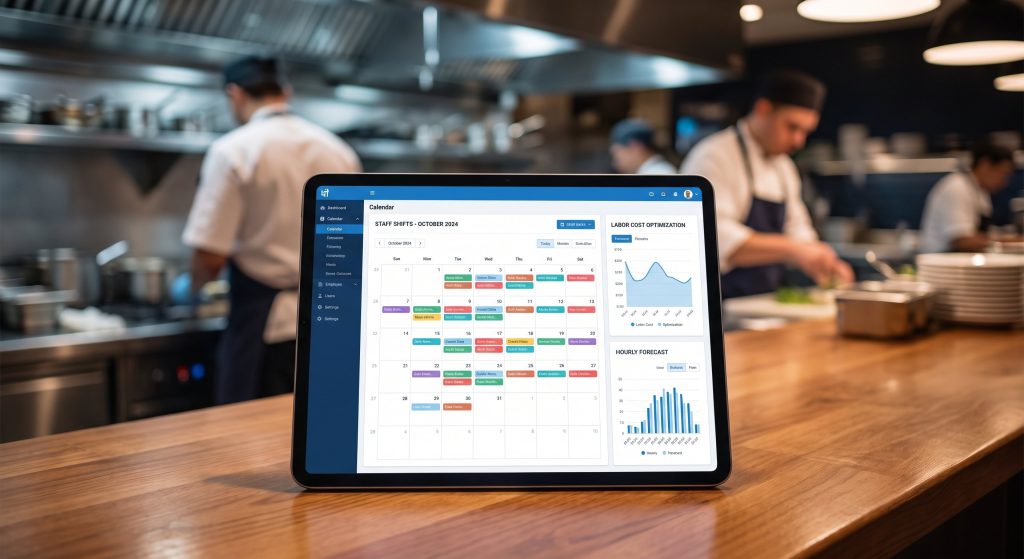
Restaurant Staff Scheduling Software: How to Cut Labor Costs Without Cutting Staff
Discover how restaurant staff scheduling software reduces labor costs, prevents overstaffing, and improves employee satisfaction.…
Read More →Discover how AI is transforming restaurant queue management with dynamic wait predictions, smart table assignments, and predictive staffing tools in 2026.
Queue management in restaurants is no longer just about handing someone a buzzer and hoping they don’t leave. In 2026, artificial intelligence is reshaping how restaurants predict demand, allocate tables, and communicate with waiting guests in real time. The result: faster turns, happier guests, and a data-driven operation that continuously improves itself.
This guide explores how AI-powered queue management works, what restaurants are actually deploying today, and what operators should expect as this technology matures over the next few years.
Traditional queue systems track wait times based on static assumptions—a table of two takes 45 minutes, a table of four takes 60. AI-driven systems replace assumptions with predictions based on real operational data.
Modern AI queue engines analyze dozens of variables simultaneously:
The result is dynamic wait time estimates that are accurate to within 3–5 minutes instead of the wide ±15-minute guesses common in manual systems. When guests receive precise, trustworthy estimates, walk-off rates plummet.
Early digital waitlist tools sent the same generic “Your table is almost ready!” text to everyone. AI-powered systems are far more sophisticated:
One of the highest-value applications of AI in queue management is predictive staffing. By analyzing historical data and real-time signals, AI systems can now recommend staffing levels 24–48 hours in advance with 80–90% accuracy.
This has a direct impact on labor cost—one of the two largest expense lines in restaurant operations. Overstaffing on a slow night is expensive; understaffing on a surprise busy night destroys guest experience and Google reviews.
AI also optimizes table assignment logic. Instead of a host manually deciding which table to seat each party, AI recommends seating that maximizes section balance, minimizes awkward floor layouts, and keeps turn pace on track across the entire dining room.
| Capability | Traditional System | AI-Powered System | Impact |
|---|---|---|---|
| Wait time accuracy | ±15 minutes | ±3–5 minutes | Higher guest trust, fewer walk-offs |
| Walk-off rate | 10–18% | 3–7% | More seated covers per shift |
| Staffing forecast accuracy | Manual / intuition-based | 80–90% accurate | Optimized labor costs |
| Table turn optimization | Manual host decisions | AI-suggested assignments | +15–20% table efficiency |
| Guest personalization | Notes in a spreadsheet | Automated CRM with ML | Increased repeat visits |
| No-show prediction | None | Risk-scored reservations | Proactive overbooking strategy |
AI queue management is not yet table stakes for every restaurant—but the gap between operators using it and those not is widening. Here’s how to position your operation:
Not anymore. While enterprise chains were the early adopters, AI-powered features are now built into mid-market platforms like QueueAt, OpenTable, and SevenRooms at price points accessible to independent operators. A single-location restaurant generating $1.5M+ in revenue will typically see positive ROI on an AI-enabled platform within 3–6 months.
AI turn-time prediction uses machine learning models trained on your restaurant’s own historical data—typically thousands of data points covering time of day, party size, server, menu items ordered, and observable kitchen pace signals. The model continuously retrains as new data comes in, improving accuracy over time.
Yes, and this is where AI adds the most value. Managing the interplay between reserved tables and walk-in demand is one of the hardest host-floor challenges. AI systems can dynamically hold or release tables based on arriving reservation windows, balancing reserved slot protection against walk-in opportunity—something humans do inconsistently under pressure.
At minimum, the system needs several weeks of historical turn-time data broken down by table size, time of day, and day of week. Most platforms build this data model in the background as soon as you go live. Full AI feature activation typically kicks in after 30–60 days of operation once enough data points are accumulated.
No—AI will augment your host team, not replace them. The judgment calls, guest interactions, and service recovery moments that make hospitality exceptional are irreplaceable by algorithms. What AI does is remove the cognitive burden of tracking 12 simultaneous waits, predicting turn times, and calculating optimal seating assignments—freeing your hosts to focus on delivering exceptional face-to-face service.

